


Belonging, Becoming, and Expanding What It Means to Be an Engineer
When I began my undergraduate engineering degree, I did not feel like I belonged.
I sat in Intro to Digital and Analog Electronics feeling overwhelmed and out of place. I was one of two women in a class of seventy. I failed my first exam. I began to internalize the idea that I was a “slow learner.” I quietly wondered if engineering was meant for people who had been taking things apart since childhood....not someone like me, who was deeply people-oriented and empathetic.
In ENED 5400: Teaching Design, we have been exploring the concept of belonging in engineering education. A key idea from our readings is that becoming an engineer is not just about mastering disciplinary knowledge. It also involves forming an identity as an engineer and navigating institutional structures that shape who feels legitimate in the field. Engineering identity develops through participation, recognition, and opportunities to engage in authentic practice.
That framework resonated deeply with my own pathway. My early struggles were not just about mastering exams. They were about identification. I did not yet see myself as “engineering material,” and I did not feel positioned as such by others.
Our readings also emphasize that engineering identity develops differently across gender and ethnicity, and that students are more likely to persist when they can connect engineering to solving meaningful societal problems. That insight explains so much of my own turning point.
I did not persist in engineering because I suddenly became better at exams.
I persisted because I found hands-on, human-centered spaces where I could act like an engineer. Beyond that I found role models, like my projects teacher who looked and thought a lot like me, and I realized that other ways of being in engineering were an option.
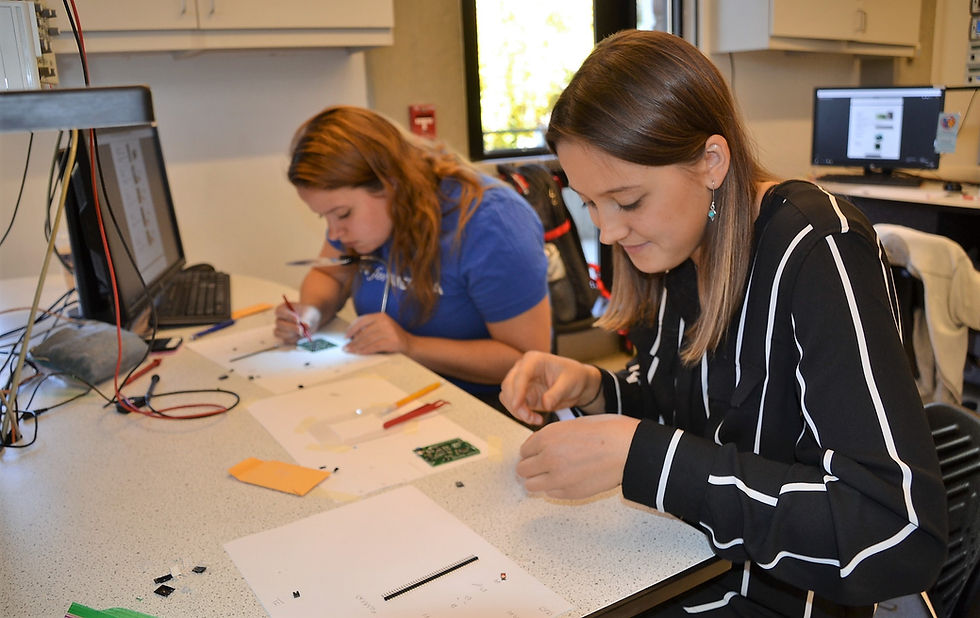
Transferring into the Integrated Design Engineering Program (formerly known as Engineering Plus at CU Boulder) changed everything for me. The program was project-based, with opportunities to complete a major project each year, and it supported building multiple identities and strengths through customizable concentrations. Mine were Entrepreneurship and STEM Teaching. The turning point, though, came in my second-year projects course. At the start of the semester, our professor asked what skills we wanted to grow, and I said programming. But once I realized other group members were more experienced, I quietly let that part of the project go. My professor noticed and pointed out that having something to learn was exactly why I should take it on. She encouraged me to program alongside my teammates rather than stepping back. One late night in the lab, I still remember getting our LED Etch A Sketch to work when the more experienced members hit a roadblock. That early confidence-building moment became a pattern: it helped me stop shying away from technical challenges just because there was a steep learning curve. We also had the chance to test our project with students from a local high school, and that connection to real users made the work feel meaningful and motivating.
That year, our team won the Engineering Expo, and my professor referred me for a job at the Integrated Teaching and Learning Laboratory as an Engineering Support Student. I worked at the hands-on lab where my projects-based class was support student use of prototyping equipment: fixing 3D printers, teaching skill-building workshops, and helping other students troubleshoot their designs. Each interaction slowly reshaped how I saw myself. I was no longer just surviving engineering coursework, I was participating in engineering practice.
Looking back through the lens of our class readings, my disciplinary knowledge grew, but more importantly, my identification changed. I began to say “we” when talking about engineers. I felt capable. I felt legitimate.
In my junior year, I discovered education and entrepreneurship courses. That was the moment I realized engineering was not limited to mechanical tinkering. It could be about solving problems with people. I worked at a summer camp. I participated in entrenpprenuerial accelerator programs. I found joy in user-centered problem solving. I began to see myself not only as a mechanical engineer, but also as an educator and entrepreneur.
Belonging, for me, did not come from fitting the stereotype of an engineer.
It came from expanding the definition.
Now, as I pursue a PhD in Engineering Education and support faculty in embedding hands-on, alumni-informed curriculum into required courses, I think often about students who are sitting where I once sat. Students who are capable but unsure. Students who are empathetic but unsure whether empathy has a place in engineering.
The curriculum work I am currently engaged in aims to make professional engineering practice visible and accessible inside required coursework, not only through internships or informal networks. When students run vibration tests on a CubeSat, program data acquisition systems, or analyze real materials failures, they are not only learning technical content. They are rehearsing identity. They are participating in the social and material practices of engineering.
Research tells us that identity and belonging matter for persistence. My own story confirms it.
In my future teaching and leadership, I want to design learning environments where students:
Encounter engineering as collaborative and socially relevant
See professional practice embedded in required coursework
Receive recognition as capable contributors
Develop adaptive expertise, not just procedural fluency
Experience engineering as something they can shape
If I could speak to my first-year self sitting in that electronics lecture hall, I would not tell her she simply needed to study harder.
I would tell her this:
Engineering is bigger than you think. There is room here for people who care deeply about others. And sometimes belonging isn’t about fitting in it’s about showing up as yourself and letting that become your strength.
Readings Referenced
Stevens, R., O’Connor, K., Garrison, L., Jocuns, A., & Amos, D. (2008). Becoming an Engineer: Toward a Three-Dimensional View of Engineering Learning. Journal of Engineering Education.
Godwin, A., Potvin, G., Hazari, Z., & Lock, R. (2016/2019). Identifying as an Engineer: Gender, Race, and Students’ Engineering Identity. ASME / related engineering identity scholarship.


Comments